Hi AI chat with AI character free: what's actually free vs paid
By FlirtAlly · October 7, 2026
Hi AI chat with AI character free: what's actually free vs paid
Key Facts
- 50% of users describe chatbots as friends or romantic partners according to Stanford research
- 80% of chat sessions focus on emotional support as found in a Stanford study
- The AI companion market was valued at $36.8 billion in 2025 according to Grand View Research
- 42.7% of the market share is held by text-based companions as reported by Grand View Research
- FlirtAlly's free tier includes 30 messages per day and unlimited memory unlike industry norms
- The FTC issued 6(b) study orders to 7 companies regarding AI chatbot monetization
The Freemium Trap: What 'Free' Really Means in AI Character Chat
You download a "free" AI character chat app, start a conversation, and everything works beautifully — for about an hour. Then the messages run out, the memory resets, and a paywall appears asking $19.99/month for the features you thought you already had. This isn't an accident. It's the business model.
According to industry analysis from GM Insights, freemium and subscription models are the dominant monetization approach for AI companion apps, and the pattern is remarkably consistent: free tiers offer basic chat while paid subscriptions "unlock advanced personalization, memory retention, voice interaction, avatar customization, and wellness-focused insights." Notice what's on that list. The gated features — memory, voice, personalization — are precisely the ones that make a character feel like someone rather than something. Free tiers are engineered to demonstrate the product, not to satisfy it.
Regulators have noticed. In September 2025, the FTC issued 6(b) study orders to seven major companies, including Meta, OpenAI, and Character Technologies, examining how these platforms monetize user engagement and handle personal information harvested from conversations. The FTC's concern is that chatbots "are designed to communicate like a friend or confidant, which may prompt some users, especially children and teens, to trust and form relationships with chatbots." A Stanford study of 1,131 Character.AI users reinforces why this matters: 50% described their chatbots as "friends" or "romantic partners," and 80% of sessions focused on emotional support. When the relationship is the product, the free tier becomes a conversion funnel aimed at people at their most invested.
The scale of the incentive is enormous. The AI companion market was valued at USD 36.8 billion in 2025 and is projected to reach USD 318 billion by 2033 — revenue that flows overwhelmingly through subscriptions and in-app purchases, not free chat.
So how do you evaluate any "free" claim before trusting it? Run this checklist:
- Message limits — Is there a daily or monthly cap, and is it disclosed before you sign up or discovered on message 31?
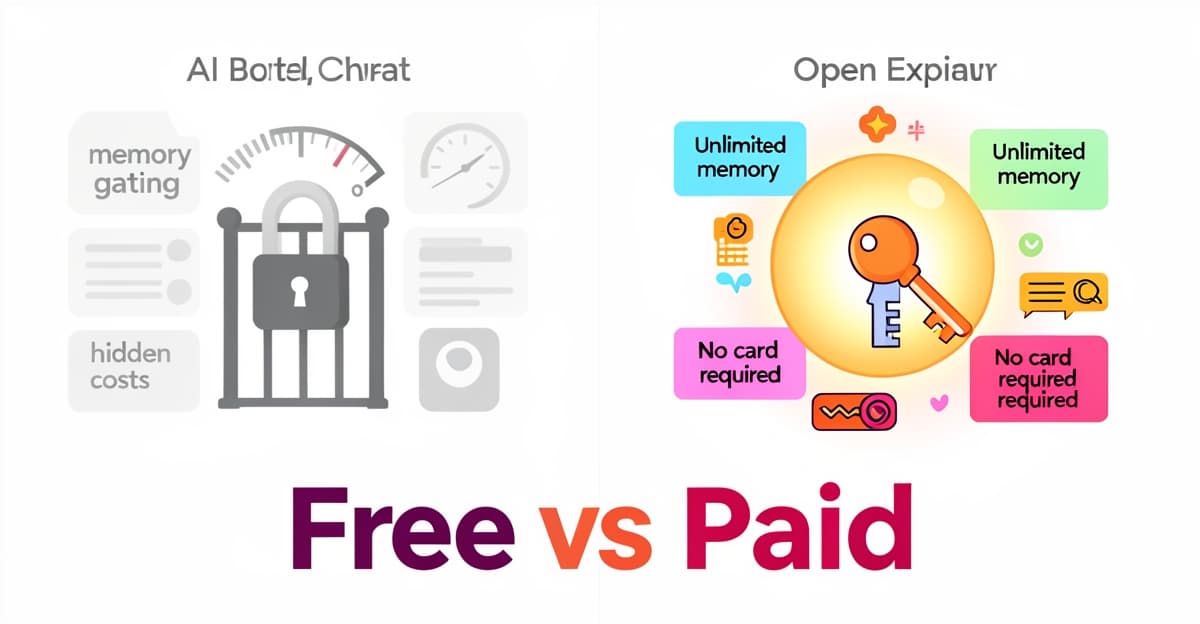
- Memory gating — Does the free tier remember your conversations, or does your character forget everything between sessions unless you pay?
- Card requirements — Does "free" demand payment details up front, converting you automatically when limits hit?
- Feature distribution — Are voice, images, and personalization spread across multiple escalating tiers to maximize upgrade pressure?
FlirtAlly's approach at launch is worth measuring against this checklist precisely because it breaks the pattern: memory is unlimited on every plan, including free, and the free tier requires no card. The industry norm exists for a reason — and knowing it is the difference between choosing a platform and being chosen by one.
The Hidden Costs of 'Free': Engagement Design, Memory Gating, and Data
When an AI companion costs nothing to download, the bill still arrives — just not in dollars. Regulators and researchers are increasingly asking who pays for "free," and the answers are reshaping how these apps are built and priced.
In September 2025, the FTC issued 6(b) study orders to seven major companies — including Character Technologies, Meta, and OpenAI — to examine exactly how companion chatbots monetize engagement and use personal information drawn from conversations. The FTC's concern is blunt: chatbots "are designed to communicate like a friend or confidant," which may prompt users, especially children and teens, to trust and form relationships with them.
The engagement question isn't hypothetical. A Stanford study of 1,131 Character.AI users found that 50% described their chatbots as friends or romantic partners, and 80% of sessions focused on emotional support. Among users with small offline social networks, intense AI use was linked to poorer well-being and increased loneliness — a finding Stanford's Diyi Yang summarizes as chatbot use not substituting for human connection. As researcher Dora Zhao put it, these companions "are designed to promote engagement."
The second hidden cost is structural: memory. Industry analysis shows providers routinely gate memory retention behind paid subscriptions, alongside personalization and voice interaction, per market research on AI companion apps. The result is a familiar squeeze — the moments that make a companion feel real (she remembers your dog's name, your bad week) become the upsell.
Not every app plays this game. FlirtAlly ships unlimited four-layer memory on every plan, including free — facts, episodic, emotional, and rolling-summary layers with semantic recall, so "remember when" works even phrased differently. The free tier at launch caps daily volume (30 messages, one companion, no card needed), not the relationship itself.
FlirtAlly's approach to safety follows the same logic:
- PG/Flirt is the default experience; the 18+ Spicy side requires ID-based age verification and a qualifying plan
- Hard-coded prohibited categories that no tier, payment, or prompt can unlock
- Media scene screening and in-app reporting built into the product
That honesty reads as a limitation in an "unrestricted app" market, but regulators are moving the other direction — new state laws in California and New York now mandate transparency and safeguards for emotionally responsive companions. Framed against the FTC's inquiry and Stanford's findings, treating safety as a feature rather than a paywall looks less like restraint and more like foresight.
