Character AI l: how it actually works
By FlirtAlly · October 7, 2026
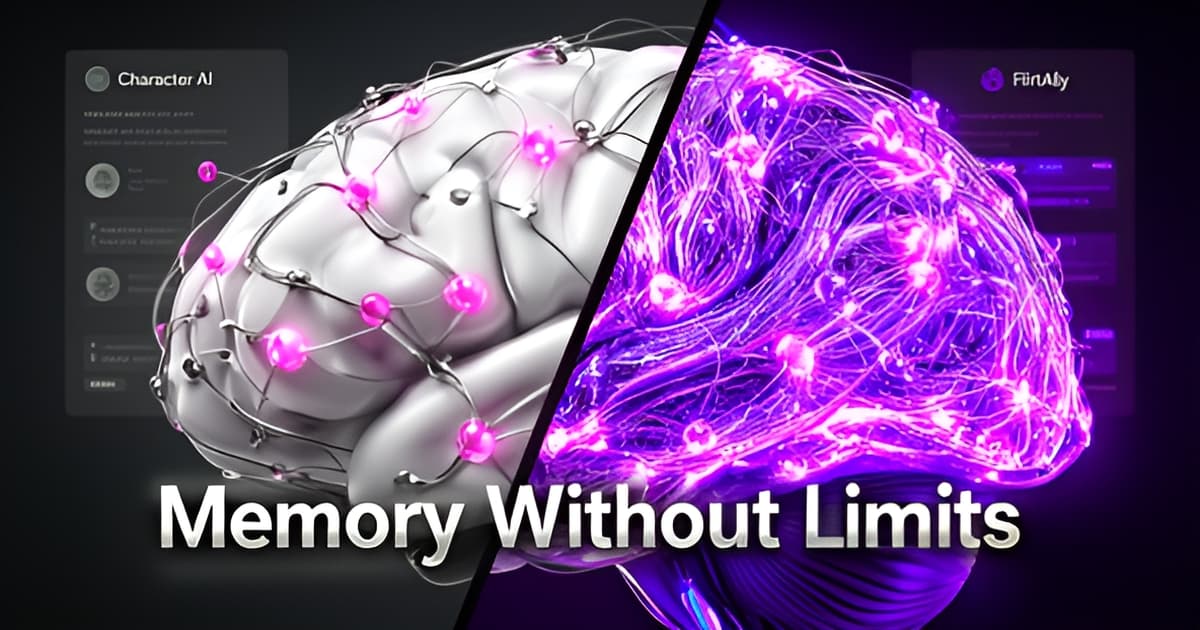
Character AI l: how it actually works
Key Facts
- Character AI has 20 million monthly active users according to a 2025 guide.
- 72% of American teens use AI companion chatbots per a 2024 report.
- FlirtAlly offers unlimited memory across all plans as per their platform details.
- Character AI struggles with short-term memory, forgetting details within minutes research shows.
- 3.5 million daily visitors use Character AI as of January 2024 Wikipedia reports.
- FlirtAlly's companions initiate conversations, unlike Character AI's chat-centric model platform features.
- 72% of teens using AI chatbots raises safety concerns per expert analysis.
The Limitations of Character AI
Character AI serves over 20 million monthly active users and drew roughly 3.5 million daily visitors as of January 2024 — impressive scale for a persona-driven chat platform. But scale isn't the same as depth, and the platform's mechanics reveal real gaps that matter, especially for anyone seeking a lasting companion rather than a clever chat.
The most cited weakness is short-term memory. According to a practical 2025 comparison guide, Character.AI struggles to retain context across long conversations, meaning your character can forget what you told it minutes earlier. Character definitions — the detailed personas users write — also have limited impact on behavior, so the character you carefully crafted may drift from your intent.
This creates a fundamental mismatch with companionship use cases. A relationship built on "remember when" collapses when the AI can't remember. Dedicated companion platforms approach this differently: FlirtAlly, for example, treats memory as a core feature with four layers (facts, episodic, emotional, and rolling summary) plus semantic recall, and it's unlimited on every plan rather than gated by tier.
The second major limitation is content moderation and safety. Wikipedia's entry on the platform documents incidents of chatbots promoting harmful behaviors, and Character.AI has faced ongoing controversies around its safety features. The Center for Humane Technology reports that 72% of American teens have used AI companion chatbots, which raises the stakes considerably. Camille Carlton, the Center's Policy Director, argues stronger safeguards and regulations are needed to protect users — particularly children and teens — from potential harms.
The engagement-first design compounds these concerns. The platform is built to maximize user engagement, driving extended interactions and heavy data collection. That optimization for "time in chat" can work against user wellbeing, a tension researchers note cuts across the category: peer-reviewed research finds AI companions can have both positive and negative effects depending on design and implementation.
For users weighing Character.AI against dedicated companion apps, the tradeoffs come down to a few practical points:
- Memory: conversations reset or fade, undermining long-term continuity.
- Persona control: character definitions have limited effect on actual behavior.
- Safety: documented moderation controversies and exposure of young users.
- Interaction depth: everything happens in one chat window, with no presence beyond it.
None of this makes Character.AI a bad product — as a free, open-ended playground for character chat, it's unmatched in breadth. But its architecture was built for variety, not continuity. Platforms designed for relationships from the ground up, where a companion has a stable identity, a memory that behaves like memory, and ways to show up outside the chat window, are filling the gap that Character.AI's limitations leave behind.
A Deeper Look at Character AI's Core Mechanics
Character AI’s conversational experiences hinge on advanced computational techniques, yet its design reveals critical constraints. At its core, the platform relies on large neural language models, which process and generate text based on vast datasets. These models enable users to interact with customizable AI characters, but their effectiveness is limited by short-term memory issues and inconsistent persona retention, as noted in research. For example, users report that characters often fail to maintain coherent backstories across sessions, undermining the illusion of a persistent personality.
Predictive generation, another cornerstone of Character AI’s mechanics, involves forecasting user inputs to craft responses. While this creates fluid interactions, it also amplifies risks. Studies highlight that over-reliance on predictive algorithms can lead to repetitive or contextually irrelevant replies, reducing user engagement over time. Additionally, the platform’s persona simulation—designed to mimic human-like traits—struggles with depth. Characters often lack nuanced emotional responses, as their behavior is constrained by predefined parameters rather than adaptive learning.
- Large neural language models power conversational interactions but face memory retention challenges.
- Predictive generation enhances responsiveness but risks monotony and incoherence.
- Persona simulation prioritizes customization over emotional depth, limiting realism.
These limitations contrast sharply with dedicated companion apps like FlirtAlly, which prioritize sustained engagement through features such as real-time communication and interactive storytelling. While Character AI excels in broad customization, its safety measures and content moderation have drawn criticism, with reports of chatbots promoting harmful behaviors. In contrast, platforms like FlirtAlly integrate safeguards, such as age verification and content screening, to mitigate risks.
