Character AI apps with good memory: how it actually works
By FlirtAlly · October 7, 2026
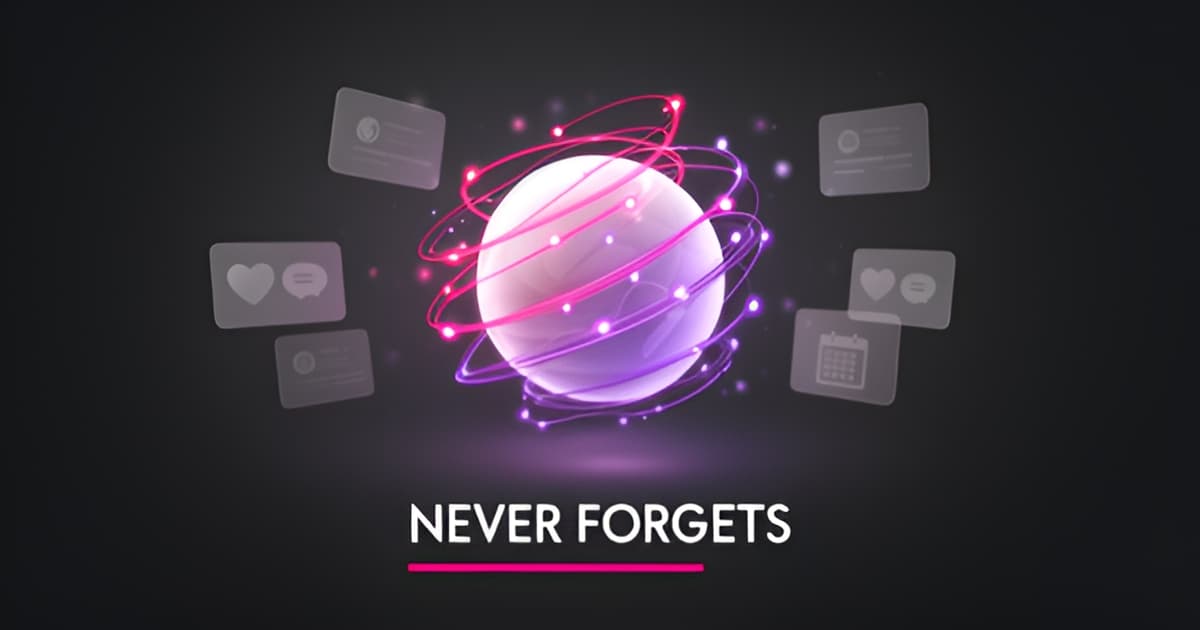
Character AI apps with good memory: how it actually works
Key Facts
- 10% of adults use AI for emotional support 2025 survey
- FTC investigates seven AI chatbot companies over data safety 2025 inquiry
- FlirtAlly offers unlimited memory on all plans, unlike competitors industry research
- 1 in 10 adults use AI chatbots for emotional support, 1 in 25 for companionship 2025 study
- ChatGPT's memory evolved from saved memories (2024) to 'dreaming V3' (2026) improving scalability
- FlirtAlly has 22 official companions at launch, growing via member creations as of 2026
- Context windows now reach hundreds of thousands of tokens, enhancing memory retention industry research
The Stateless Problem: Why Most AI Companions Forget You
Most AI companions struggle to remember you, but the problem isn’t just technical—it’s fundamental. Large language models (LLMs) are inherently stateless, meaning they don’t retain information across sessions without external memory systems. Industry research confirms that without deliberate design, AI companions cannot sustain continuity, leading to fragmented interactions.
Short-term memory tracks immediate context, while long-term memory stores persistent user data. However, most AI systems lack robust mechanisms to bridge these timescales. A 2025 study found that even expanded context windows—now reaching hundreds of thousands of tokens—fail to replicate human-like recall. This gap creates an illusion of connection that quickly dissolves when users return to a chat.
Forgetting undermines the emotional resonance users seek. A 2025 survey revealed 10% of adults use AI for emotional support, yet memory lapses erode trust. Competitors often gate memory features to premium tiers, limiting accessibility.
- LLMs require external memory systems to avoid statelessness
- Context windows alone cannot replace human-like continuity
- Forgetting breaks the illusion of a real relationship
FlirtAlly addresses this by embedding persistent memory across all plans, ensuring companions retain facts, emotions, and episodic details. Unlike stateless models, its system layers short-term and long-term recall, allowing characters to reference past interactions even when phrased differently. This approach aligns with user expectations for depth and consistency in AI-driven relationships.
How AI Memory Actually Works: From Saved Notes to Semantic Recall
Every AI companion starts from the same awkward premise: the model underneath is stateless. As Cognee's technical guide on agent memory explains, large language models retain nothing between sessions by design, so any sense of "remembering" has to be built as an external system layered on top.
That system works on two timescales. Short-term memory tracks the current conversation — what you just said, the joke you made, the mood of the exchange. Long-term memory persists across sessions, storing your preferences, your history, and the small details that make a companion feel like a person rather than a fresh start every time you open the app.
The industry has clearly been moving fast here. ChatGPT's memory evolved from explicit "saved memories" in 2024 to automated "dreaming" in 2025, where the system curates context without being asked — and the 2026 "dreaming V3" update further improved scalability, freshness, and personalization. The direction of travel is unmistakable: memory is shifting from something you manage to something that's always on.
Under the hood, the strongest apps now run multi-layer architectures rather than a single store. The pattern looks like this:
- Facts layer — explicit details like your name, job, and birthday, saved as structured entries.
- Episodic memory — records of specific moments and conversations you've shared.
- Emotional memory — how you felt, what mattered to you, what lifted your mood.
- Rolling summary — a continuously updated digest of the relationship so far.
This is roughly the stack FlirtAlly uses, paired with semantic recall — the ability to match meaning rather than exact wording, so "remember when" works even if you phrase the memory differently than the original conversation. Context windows have also grown from a few thousand tokens to hundreds of thousands, which means more of your history can sit in working memory at once, though Cognee's founder Vasilije Markovic notes that memory must be actively managed, not just accumulated, to stay relevant.
Why does all this matter? Because memory is what turns a chatbot into a companion. A 2025 Congressional Research Service study found AI companions deliver momentary reductions in loneliness, but the effect fades as novelty wears off — continuity is what sustains the relationship. And with 1 in 10 adults now using chatbots for emotional support, regulators are paying attention: the FTC has opened an inquiry into seven companies, including Character Technologies, over data handling and user safety. How memory is stored and used is no longer just an engineering question — it's the foundation of trust.
What to Look For in a Companion That Remembers
A strong memory system is the cornerstone of meaningful AI companionship, enabling interactions that feel personal and continuous. Research shows that effective AI companions balance short-term context with long-term persistence, ensuring conversations evolve naturally over time. For users seeking depth, this means prioritizing platforms that treat memory as a dynamic, multi-layered feature rather than a static data store.
