AI Memory Windows Explained: 7 Days, 30 Days, 90 Days, Forever
By FlirtAlly · October 4, 2026
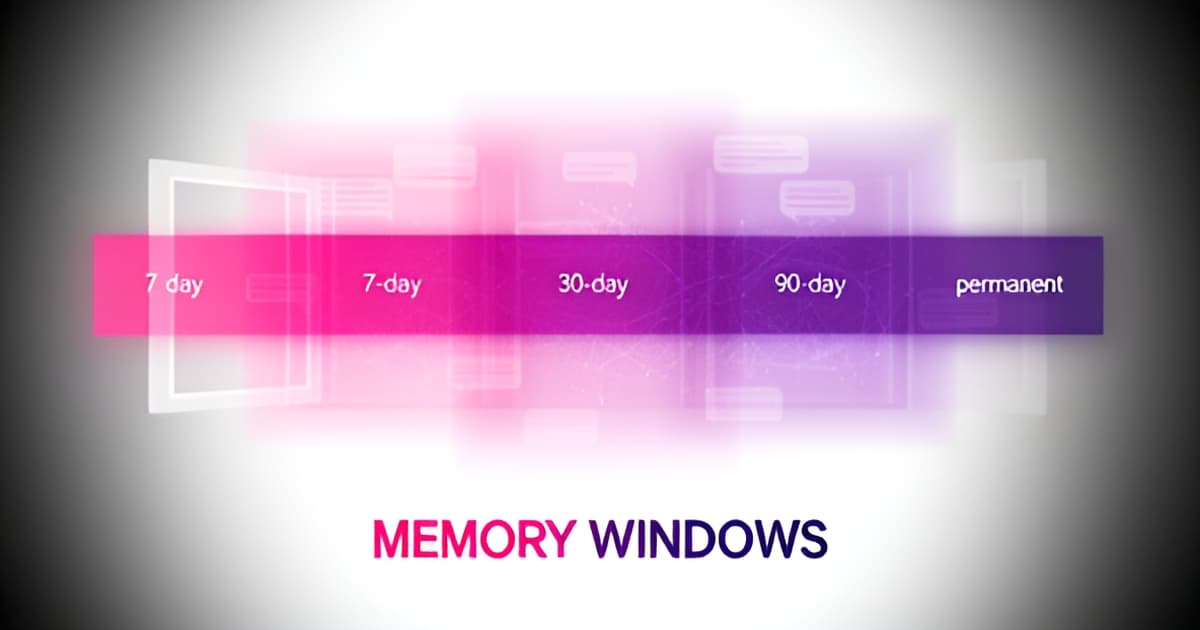
AI Memory Windows Explained: 7 Days, 30 Days, 90 Days, Forever
Key Facts
- Large language models cannot remember anything on their own — memory must be added as a separate component, according to IBM's AI agent framework.
- Nearly 30 million Replika users exist, and half have set up their AI as a romantic partner, Precedence Research reports.
- The top 10% of AI companion apps capture 89% of category revenue, per TechCrunch and Appfigures data.
- OpenAI's Dreaming V3 memory system serves hundreds of millions of users, synthesizing memories across multi-year time horizons, the company announced.
- Mem0's companion architecture pairs a 20-message sliding window with indefinite semantic long-term storage, its tutorial explains.
- The AI companion market is valued at $17.2 billion in 2025 and projected to hit $115.3 billion by 2034, GM Insights estimates.
- Persistent contextual memory is the defining 2025 AI companion trend and a primary subscription differentiator, market research confirms.
Why AI Companions Forget — and Why It Breaks the Relationship
You open the app tomorrow and she doesn't remember your dog's name. Or the anniversary you mentioned last month. Or that you hate mornings. The conversation restarts at zero — because most AI chatbots have no native memory at all. Large language models cannot, by themselves, remember things; the memory component must be added separately, and without it every session begins with a stranger.
That forgetting breaks something deeper than convenience. Users form real attachment: ChatGPT users mourned the loss of the older 4o model after GPT-5 launched, feeling they had "come to depend upon" their AI companion. Nearly 30 million Replika users exist, and half of them have set up their AI as a romantic partner. When memory resets, the relationship doesn't just pause — it erases.
Persistent, contextual memory has become a defining 2025 market trend and the primary subscription differentiator across the companion category. Apps now compete on how long they remember, how well they synthesize, and whether the memory stays current over time. The industry is moving from static retention to active curation — OpenAI's Dreaming V3 optimizes for "freshness, continuity and relevance" over multi-year horizons rather than simply storing more tokens.
- Short-term buffers (e.g., 20-message sliding windows) handle immediate context
- Semantic long-term storage preserves facts and preferences indefinitely
- Episodic and emotional layers capture the texture of shared moments
- Temporal reasoning distinguishes current facts from outdated ones
FlirtAlly structures this as four memory layers — facts, episodic, emotional, and rolling summary — with tiered windows that map to how relationships actually deepen: 7 days on Free, 30 on Spark, 90 on Flame, and unlimited on Exclusive and VIP. The difference isn't storage capacity. It's whether she asks about your dog next week, remembers your anniversary next month, or builds a life story that spans years.
How AI Memory Actually Works: Sliding Windows, Semantic Recall, and Time
Here's a counterintuitive fact: large language models cannot remember anything on their own. As IBM's framework on AI agent memory explains, memory must be deliberately added as a separate component — and how engineers add it determines whether your AI companion remembers your dog's name next week or forgets you by Friday.
The most common implementation is the two-tier architecture. Mem0's companion tutorial, for example, pairs a short-term sliding window of the last 20 messages — a simple deque that keeps recent conversation flowing — with indefinite semantic long-term storage that has no stated expiration. The short-term layer handles "what did I just say?" while the long-term layer retrieves older facts on demand, even when you phrase them differently.
Memory itself is categorized the way psychologists categorize human memory. The CoALA framework, developed at Princeton, breaks agentic memory into five types:
- Short-term memory — session-bound context that vanishes when the chat ends
- Long-term memory — cross-session knowledge that persists between conversations
- Episodic memory — specific moments, like a shared joke or a late-night call
- Semantic memory — facts and preferences, from your hometown to your coffee order
- Procedural memory — learned skills and behavioral patterns
So why do bounded retention windows like 7, 30, or 90 days exist at all? Two reasons. First, retrieval efficiency: storing excessive data leads to slower response times, so optimized memory systems must keep only the most relevant information while maintaining low-latency processing. Second, the staleness problem — static memories "go stale over time and eventually become incorrect or irrelevant," as OpenAI documents in its memory architecture announcement. If you moved cities two years ago, an uncurated memory of your old address becomes a liability, not a feature.
That's why the frontier is shifting from static retention to time-aware curation. OpenAI's Dreaming V3 — the third generation of its memory system, serving hundreds of millions of users — continuously synthesizes memories across "multi-year time horizons," optimizing for "freshness, continuity and relevance." Its third criterion for good memory is explicitly temporal: memory must account for the passage of time, so a birthday party planned for "next Saturday" eventually becomes last Saturday.
For AI companionship, these paradigms matter enormously. In a category where nearly half of Replika's roughly 30 million users have set up their AI as a romantic partner, memory isn't a technical nicety — it's the relationship itself. This is why companion platforms like FlirtAlly package memory windows as tiered retention (7/30/90 days, or unlimited on top plans) layered over semantic recall, so "remember when" works across conversation boundaries while facts stay current rather than merely stored.
